How NexaWeld Deployed QuillCMS to Build Their Catalog and Website at Same Time
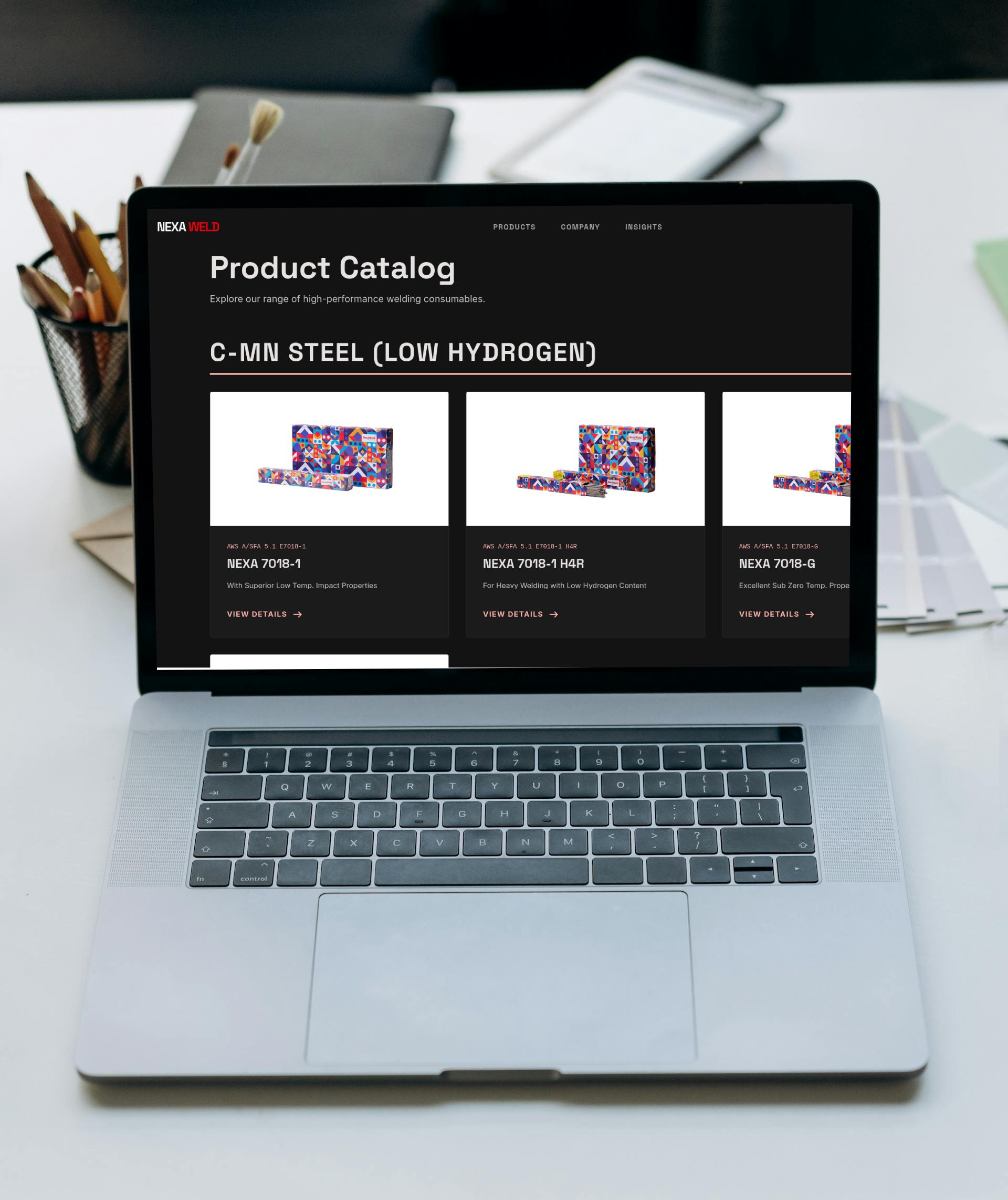
Using QuillCMS, Nexa Weld upgraded from Wordpress to build a quicker responding website alongside re-using there database for building their catalog booklet!

Arpit
Industrial-Grade Development: How QuillCMS Powered Nexa Weld’s Complex Product Ecosystem
Author: Senior Technical Case Study Writer & Product Evangelist
Target Audience: CTOs, Tech Leads, Enterprise Product Owners
Reading time: 12 minutes
When Nexa Weld—a global leader in metallurgical and welding technology—approached us to rebuild their digital product ecosystem, the requirements read like an ERP specification. They needed to catalog thousands of highly engineered welding consumables, each described by dozens of interdependent chemical, mechanical, and regulatory parameters. The end product had to serve both as an internal master data hub and a customer-facing technical library, complete with on-demand generation of print‑ready technical data sheets (TDS). Traditional CMS platforms would buckle under the relational complexity; custom ERP development would burn months of engineering time. Instead, we delivered the entire system in weeks, not quarters, using QuillCMS and its underlying VisionPHP framework.
This case study dissects how QuillCMS’s “Service‑First, Widget‑Centric” architecture transformed a seemingly impossible industrial cataloging challenge into a zero‑defect, high‑velocity delivery. We’ll explore five technical pillars that made the difference—and why they matter for anyone building precision data systems at enterprise scale.
1. The Scaffolding Core: Relational Integrity at Generator Speed
In standard CMS environments, product data beyond basic fields quickly degenerates into a swamp of “Custom Fields” and flat metadata tables. Filtering on chemical composition, mechanical strength, or gas mixture ratios becomes a SQL nightmare, and search performance degrades exponentially. For Nexa Weld, that approach was a non‑starter.
QuillCMS’s Generator allowed us to define a 10‑table relational database for a single product entity—without writing a single DDL statement by hand. Using a declarative schema definition, the framework’s scaffolding engine materialised the following structure in seconds:
products(master product ID, SKU, classification, application group)chemical_properties(element, percentage, tolerance)mechanical_strengths(tensile, yield, elongation, impact energy, test temperature)gas_compositions(shielding gas mixtures for MIG/TIG variants)packing_specs(spool weight, dimensions, pallet configurations)global_approvals(ABS, DNV, Lloyd’s, etc., with document references)… and four additional auxiliary tables linking certifications, recommended base materials, storage conditions, and welding positions.
Each table is a first‑class citizen with foreign‑key integrity, proper indexing, and—critically—fully searchable and filterable columns in the QuillCMS administration grid. That means an engineer can instantly filter all products with nickel content > 2.5%, impact energy above 50 J at -40°C, and valid ABS certification. In a flat‑meta world, such a query would demand complex joins across key‑value pairs; here, the database schema is the specification, and the UI consumes it natively.
Why it matters: We didn’t just store data—we structured it for performance and long‑term maintainability. The Generator produced 100% of the relational plumbing while the team focused on verifying domain‑specific constraints. No ORM magic, no hidden overhead—just clean, predictable SQL backed by VisionPHP’s PSR‑7 routing.
2. Development Velocity: Where Low‑Code Meets Custom Logic
Time‑to‑market pressure demanded that we deliver a fully functional back office, public API, and user‑facing catalogue within an aggressive timeline. QuillCMS’s code‑generation engine produced the entire stack for each of the ten tables—Models, Controllers (with full CRUD and listing endpoints), PSR‑7 Routes, and Twig‑based Views—in a single command. That’s hours of boilerplate eliminated before the first coffee of the day.
But the real magic lies in how the framework preserves hand‑crafted business logic. Every generated file contains designated User Custom Logic blocks—protected sections that are never overwritten on regeneration. When Nexa’s metallurgists introduced a complex validation rule (e.g., “if the product is a low‑hydrogen electrode, the moisture content field becomes mandatory and must be ≤ 0.4%”), our developers added that logic once, inside a safe block, and subsequent schema changes never touched it.
This hybrid approach allowed us to:
Iterate on the data model fearlessly, re‑scaffolding entire modules in seconds.
Embed intricate domain rules (alloy‑specific phase transformations, packaging dimension constraints) directly in the service layer.
Keep the team’s focus on differentiation—the 20% of code that defines Nexa’s IP—while the generator handled the other 80%.
The result? A 5× acceleration compared to conventional full‑stack development, with zero regression in code quality.
3. The Booklet Builder: From Relational Data to Print‑Ready TDS
In the welding industry, the Technical Data Sheet (TDS) is a legal document—a precise, formatted record of a product’s characteristics. Nexa required that any approved internal user could, with one click, turn a database record into a downloadable PDF suitable for direct print or customer submission.
We didn’t bolt on a third‑party service. Instead, QuillCMS’s Booklet Builder—a framework‑integrated PDF generation engine—was extended to consume the relational graph of a product. A dedicated template engine (built on top of a specialised Twig extension) traverses the master product and its child tables, rendering them into a multi‑page, branded layout that includes:
Header with company certification marks and document control numbers.
Chemical composition table drawn from
chemical_properties.Mechanical properties and testing conditions from
mechanical_strengths.Approvals matrix with expiry dates from
global_approvals.Packing and storage guidelines from
packing_specsand auxiliary tables.
The engine compiles the page‑level design on‑the‑fly, producing a vector‑perfect PDF. No manual assembly, no data duplication. When a chemist updates a manganese value, the TDS instantly reflects it. This closed‑loop system eliminated the error‑prone desktop‑publishing workflow that had plagued Nexa’s previous process and ensured every TDS was always “single source of truth.”
For the development team, integrating the Booklet Builder required less than 300 lines of presentation‑layer logic, because the heavy lifting—data hydration, pagination, and PDF rendering—was already part of the framework’s service layer.
4. Advanced Bulk Management: Breaking the Data‑Entry Bottleneck
Industrial product catalogs suffer from a unique curse: they are too rich to maintain manually, yet too varied for simple spreadsheet imports. Nexa’s product managers routinely needed to update packaging specs, re‑assign approval certificates, or replace a batch of product images across dozens or hundreds of SKUs. Traditional CMS list views force an operator to edit each record individually—a recipe for fatigue and inconsistency.
QuillCMS’s Bulk Action Engine introduces a specialised grid interface that treats entire selections of records as a single transactional unit. Administrators can:
Select products by filtered criteria (e.g., all rutile‑flux cored wires with 1.2 mm diameter).
Initiate a batch update of relational data, such as adding a new DNV approval to every selected item, including document uploads.
Replace or annotate multiple product images simultaneously, with the engine handling file renaming and storage references in one atomic operation.
Preview changes through a differential view before committing, maintaining a full audit trail.
Under the hood, the engine exploits VisionPHP’s service‑oriented command bus, queuing bulk write operations as coherent jobs. This ensures that even partial failures roll back gracefully, maintaining relational integrity across all affected tables. What used to take Nexa’s team an entire afternoon now completes in under two minutes—with complete confidence.
5. Performance & Industrial Aesthetic: The Nexa Theme
A data system for welding engineers must convey precision and durability—not just in its logic, but in its appearance. We designed the Nexa Theme, an “Industrial Brutalism” aesthetic built on Tailwind CSS v4, characterised by:
Deep, low‑glare dark backgrounds with high‑contrast monospace typography.
Functional use of orange and steel‑blue accents that mirror real‑world industrial safety colour coding.
Dense, grid‑based data presentations that respect the user’s need to scan large datasets rapidly.
But a visually striking UI means nothing if it loads slowly. The team moved decisively beyond standard CDN‑based Tailwind inclusion. Instead, we configured a fully compiled, minified local CSS pipeline that strips out every unused utility class, resulting in a stylesheet of under 18 KB (gzipped). Combined with the framework’s aggressive caching layer (Twig templates compiled to bytecode, query result caching for reference data), the Nexa application delivers sub‑second page loads across the entire admin and public catalogue, even on restricted industrial networks.
Equally important, the deterministic CSS build eliminates runtime style recalculation, guaranteeing pixel‑perfect, zero‑defect rendering across the locked‑down corporate browsers Nexa’s clients are forced to use. This is not a marketing website; it’s a piece of operational technology, and it behaves like one.
Conclusion: Beyond CMS, Into Industrial‑Strength Platforms
Nexa Weld’s new product ecosystem is live, handling thousands of complex welding consumables and serving as the single source of truth for both internal stakeholders and global customers. The QuillCMS‑powered solution replaced a fragile patchwork of legacy spreadsheets and desktop publishing with a unified, relationally sound, and blisteringly fast web application.
This project reaffirms that QuillCMS is not merely a CMS. It is a high‑precision development tool that bridges the gap between raw code and automated scaffolding. For CTOs and technical leaders grappling with data‑intensive industrial domains, it offers a compelling proposition:
True relational modelling instead of flat metadata straitjackets.
Generator‑driven velocity that never sacrifices the ability to write deep custom logic.
Framework‑embedded engines for bespoke output (PDFs, bulk operations) that would require months of integration on other platforms.
Engineered performance and aesthetics that match the rigour of the industries being served.
In a market flooded with “low‑code” platforms that compromise at every corner, QuillCMS demonstrates that you can have the speed of scaffolding and the control of a custom framework. For Nexa Weld, that meant delivering an industrial‑grade application at 5× the speed of standard development—with the quality a zero‑defect environment demands.
If your next enterprise product challenge feels too complex for a CMS and too slow for custom development, it’s time to look at the tool that exists precisely for that void. That tool is QuillCMS.
Comments (0)
Leave a comment
No comments yet. Be the first to share your thoughts!